A Studiospectre Production
by Richard Farmer, Eleanor Halsall, Morgan Lefeuvre and Carla Mereu Keating
Hallowe’en, literally the evening before All Hallows Day (1 November) and All Souls’ Day (2 November), is the time of year when thoughts turn towards the darkness, death and the belief that briefly, the door between heaven and earth is open, or at least ajar… In the Catholic tradition it is customary to visit the graves of departed relatives with flowers or even, in some cultures, food; however, secular Halloween seems to involve gouging out pumpkins and dressing up to scare the neighbours into handing over their chocolate rations. Long before this became the norm film itself had broadened the creative imagination that had long been present in the theatre; suddenly there were multiple opportunities to create mystic and ghostly forms on screen.
Italian filmmakers and studio workers could draw artistic inspiration from a rich pool of folk traditions and religious rituals associated with the commemoration of the dead, but in the 1930s local film companies appear to have steered away from screen representations of spirituality, (violent) death, and the afterlife. These subjects were to be handled carefully if one wished to avoid upsetting the fascist film office. If producers working under Mussolini’s regime would not risk investing in a project which could later be excised or banned altogether, foreign-made films distributed in the country, on the other hand, were often censored because of their portrayals of murders, suicides, and hypnotic and psychic phenomena (items banned by film law 3287/1923). An example is Ernst Lubitsch’s Rosita (1923), where a quick, hazy sight of a dead body hanging from the gallows was asked to be removed (censorship file 19405).
Graphic images of violent and pre-meditated deaths were not the sole concern at the Italian film office – references in intertitles and audible dialogue were not welcome either. Fritz Lang’s Liliom (1934) was only approved on condition that all visual and verbal references to suicide (a religious taboo) were removed (censorship file 28544).
In France the very idea that a studio might be haunted is rarely mentioned and always derided in the land of Descartes! Given the feast days that follow Hallowe’en, studios, like most companies and shops, are closed, and this time of year is not associated with any particular event in the film industry. When a few fantastic creatures appeared on film sets during the shooting of films such as Julien Duvivier’s La Charrette fantôme (1939) or Claude Autant-Lara’s Sylvie et le fantôme(1942), the press took the opportunity to praise the skill of the technicians in the art of visual effects, without seeing the slightest mystery in them.

Croyez vous aux fantômes

Non, mais
In July 1937, Le Petit Journal ran the headline ‘Un attentat mystérieux dans un studio de Courbevoie’ (‘A mysterious attack on a studio in Courbevoie’), reporting that a parcel bomb had been found hanging on the studio’s front door and that the concierge had declared it to be ‘the fourth mysterious event that has taken place in the haunted studio in the last year’ [Le Petit Journal, 1937]. On inspection, the journalist discovered a modest cardboard box containing a harmless alarm clock and took the opportunity to gently mock the credulity of the concierge and the local population, who had been a little too quick to panic! Even in fiction taking place in the world of cinema, when images of ghosts or haunted studios are evoked, it is always to be mocked. In Le studio du mystère, an adventure novel by Desclaux published in episodes in the press, when the director of a studio where accidents were multiplying began to wonder about the mysterious origin of this misfortune, he was immediately called a superstitious coward.
But while no one in the French studios seemed to believe in ghosts, there were occasional questions about the existence of ghosts across the Channel. ‘A ghost in the studio’ headlined La Liberté in August 1934 about an anecdote that occurred in a London studio. The article referred to the mysterious phenomenon of a character appearing on the film in superimposition, despite several takes to try and solve the problem. ‘After four attempts, we were forced to agree that something extraordinary was happening in the bewitched studio’, concluded the journalist. A ghost? Why not, as long as he’s British!
Indeed! And several reports do exist that ghosts have made their presence felt in some film studios in the UK. Perhaps this isn’t surprising given that a number of British studios were erected on the estates surrounding established properties, some of which were hundreds of years old. At Shepperton, Littleton Park house, partly a 17th century construction, was adapted for use as dressing rooms and an administrative block, and claims of a supernatural presence date at least to the 1950s. The Shepperton ghost is said to be either Caroline Wood, lady of the manor in the 1830s, or a young woman who tragically threw herself from the minstrel gallery having been spurned by her lover. The apparition has been seen ‘flitting through a side window in the house facing “A” stage’, while its soft footsteps have been heard in the house’s corridors and its presence felt in Star’s dressing rooms (Daily Cinema – Shepperton studios number, Sept. 1958: 17; Threadgall, 1994: 4).
Appropriately enough for a studio often associated with horror and the macabre, the Hammer facility at Bray, built on the grounds of mid-18th-century Down Place, is said to be inhabited by a spectre known as the Blue Lady (Warren, 1995: 15). Neighbouring Oakley Court, a neo-Gothic pile erected in the 1850s, was also used by Hammer as an eerie and atmospheric backdrop in films including The Man in Black (1949) and The Brides of Dracula (1960). After its conversion to flats in the late 1960s ‘paranormal activity in and around the house intensified to the extent that it became described not only as haunted but evil’ (Brian Langston, ‘The Real Hammer House of Horror: Oakley Court Hotel Windsor’)
Reports emerged from the small studio at Bushey, situated in the grounds of Lululuand, a late-19th century house built to resemble ‘a German castle of the middle ages’ (Tatler, 21 Aug. 1901: 363), that the unquiet spirit of Lulu, second wife of the artist Sir Hubert von Herkomer and after whom the property was named, walked abroad. On one occasion, the ghost, described as ‘a luminous blue lady,’ was making its way through the studio, ‘frightening two young starlets and scaring a producer out of his wits’ (Reveille, 26 Nov. 1956: 15).
From blue ladies in the studio we move to green ladies on the screen. In Blithe Spirit (1945), the ghosts of Elvira (Kay Hammond) and Ruth (Constance Cummings) were conjured using make-up and lighting – and actors ‘looking through’ spectral presences that their characters cannot see – although some poltergeist shots, which saw a chair and vase of flowers move through the air seemingly unaided, were sufficiently impressive for the film, and its special effects supervisor Tom Howard, to win an Academy Award for best visual effects

Kay Hammond and Constance Cummings in Blithe Spirit
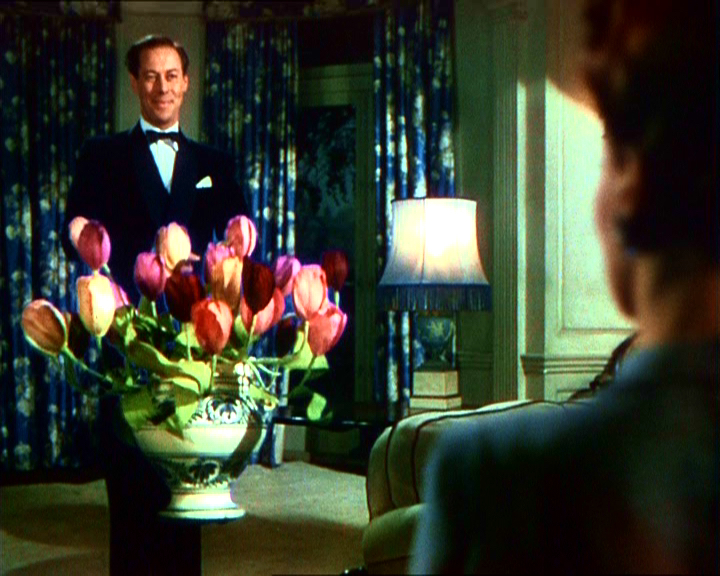
Rex Harrison in Blithe Spirit
A couple of years later, innovative methods were used at Denham to create the ghost of Hamlet’s father in Laurence Olivier’s celebrated cinematic version of Shakespeare’s Danish tragedy. Film editor Helga Cranston noted in her diary that her first glimpse of Olivier at the studio’s sound stage, where he was shooting test footage for the ghost scene, was ‘unusual, to say the least’:
Olivier was dressed in a white bathrobe, his face and hands were blackened and in his mouth he had a lit bulb which was connected to a battery tied to his back underneath the robe. / “He stood surrounded by technicians, watching them intently while they were preparing the shot […] At first I couldn’t understand the reason for the blackened face and the light bulb in the mouth, but then it dawned on me that Olivier wanted the ghost to appear like a negative image. It was a daring idea and I wondered how it would look on screen. Tales of a film editor: the making of Olivier’s Hamlet | BFI
Not good enough, it seems, for the idea to be pursued much further, and the ghost as eventually brought forth was more conventional in appearance, although vaseline was smeared on the camera lens to provide the spectre with an indistinct outline and fluorescent paint was used in conjunction with ultra-violet light to enhance its supernatural appearance (Barker, 1953: 306-7; Kine Weekly, 29 June 1950: 11). The sound design used to create the ghost’s auditory presence was similarly inventive. The idea that an amplified heartbeat should presage each of the ghost’s visitations was borrowed from a Parisian theatrical production, and Olivier achieved the ghost’s uncanny voice by amplifying his whispered lines and then playing them back at a reduced speed to give them a deeper, other-worldly quality. After unimpressed critics described the ghost as sounding as if it was speaking through ‘a loudspeaker at a greyhound meeting’ (Yorkshire Post, 5 May 1948: 4) or ‘a very dud wireless set’ (Picturegoer, 5 June 1948: 12), alterations were made at Denham, where technicians spent three weeks manipulating the soundtrack and removing some of the echo to create a voice that had ‘greater clarity yet retains its sepulchral tones’ (Rugby Advertiser, 29 June 1948: 3).
The netherworld returned to haunt Italian screens in the early 1940s. Initially, the controversial topic was approached in a humorous way, as in Allegro fantasma (1941), filmed at Cinecittà and interpreted by emerging Neapolitan comedian Totò. The invisible presence of late uncle Pantaleo’s ‘happy ghost’ materialised out of thin air through some simple mechanical tricks.
The ‘happy’ ghost
1942 saw the filming (mostly on location, near the lake Como) of Malombra, one of the screen adaptions of the homonymous gothic novel by Antonio Fogazzaro (1881). The magnetic Isa Miranda embodies the title role of Marina di Malombra, a young woman who becomes murderous after believing herself to be the reincarnation of her ancestor. In the first screen adaptation of the novel, filmed at Cines in 1916 and starring silent diva Lyda Borelli as the troubled femme fatale, the deterioration of Marina’s mental health is powerfully conveyed through a series of long cross dissolves that create a disturbing, uncanny superimposition of the two women captives.

Malombra in WW1
In the 1940s version of Malombra, this spectral dimension is largely lost, although the dramaturgy is carefully assembled by means of an eerily sound/voice track, slow camera movements, sustained editing tempo, and elaborate chiaroscuro lighting.

Malombra in WW2
The 1950s offered more technical possibilities to Italian filmmakers to achieve spectacular visual effects (known as ‘trucchi’ in Italian) thanks to renewed experimentation with studio technologies and lab-based techniques (e.g., back projection, double exposure, colour). A notable example is Vittorio De Sica’s Miracolo a Milano (1951), the screen adaptation of a 1943 treatment written by Cesare Zavattini and Antonio de Curtis and illustrated by Lotte Reiniger (De Santi and De Sica, 1999: 68-76). Shot largely on the outskirts of Milan and in various location across the city, this costly neorealist-fairy-tale-project featured the collaboration of De Sica and cinematographer G. R. Aldo with Ned Mann, the American special effect artist who directed all the phantasmagorical elements of the film.
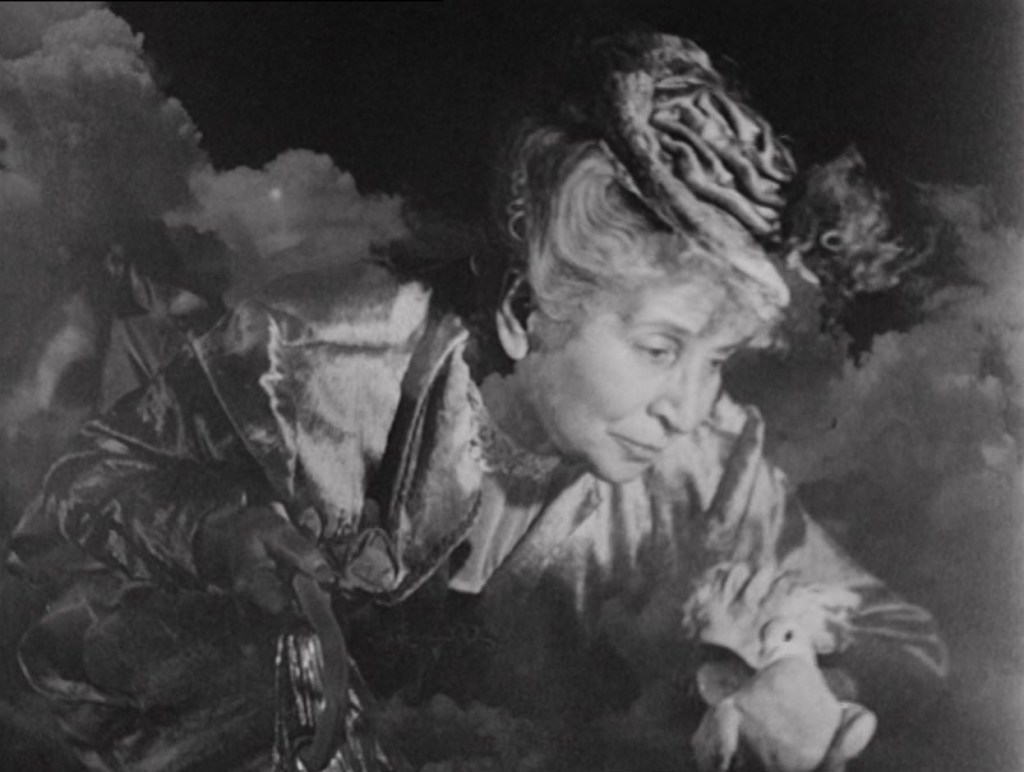
Emma Gramatica as the ghost of Totò’s mother

Flying over the Duomo
Although we could find no tales of spectral presences reported in German film studios, an early 20th century obsession with the occult imagined all manner of spectres to create the uncanny. From the appearance in the mirror of the murderous Doppelgänger in The Student of Prague (1913) to the creepy forms used in Caligari (1920), Nosferatu (1922) and beyond, Germany has a large catalogue of films containing the Spuk (ghost) in their titles! Ghosts on film occur regularly in castles and villas, but puppet shops (Spuk im Puppenladen, 1935), artist studios (Spuk im Maleratelier, 1935), museums (Spuk im Museum, 1938), even a shop window (Spuk im Schaufenster, 1941) are also granted a haunting as the form shifts from dark, mysterious places to the typically capitalist loci of retail.
Spuk im Schloß (Zerlett, 1943-45) presents plenty of screen ghouls and ghosts but, as with The Wizard of Oz (1939), rationality is restored with a behind-the-scenes glimpse revealing their mechanical creation:


Screenshots from Spuk im Schloss
A visitor to British and Dominion commented that a film studio ‘is always haunted by its own past in the shape of fragments of old sets not yet demolished’ (Yorkshire Post, 11 July 1933: 8) and this example is another way to consider the spectral presence in studios. An iconic building such as Germany’s Tonkreuz studio at Babelsberg has hosted film production for nearly one hundred years. Surely it must be haunted? Looking around the premises, it’s possible to find spectral traces of some of the people who once worked there. Hidden in the upper reaches of the lighting bridges, names have been etched into the bricks and elsewhere on the Tonkreuz studio’s skin.

Tonkreuz Graffiti

Interior of Tonkreuz
The interior is marked by the ghostly traces of previous constructions – here was once a window, there was once a roof…and oh, what tales they could tell!
References
Anon., ‘Gossip of the hour’, Tatler, 21 August 1901: 363.
Anon., ‘A visit to British and Dominions’, Yorkshire Post, 11 July 1933: 8.
Anon., ‘Diary of a Yorkshireman’, Yorkshire Post, 5 May 1948: 4.
Anon., ‘Stage and screen’, Rugby Advertiser, 29 June 1948: 3.
Anon., ‘Cheating the camera and the mike’, Kinematograph Weekly, studio review, 29 June 1950: 11.
Anon., ‘Film ghost caused a scene’, Reveille, 26 November 1956: 15.
Anon, ‘The Shepperton story: historical background, Daily Cinema – Shepperton studios number, September 1958: 17.
Felix Barker, The Oliviers (Philadelphia: Lippincott, 1953): 306-7.
Lionel Collier, ‘Shop for your films’, Picturegoer, 5 June 1948: 12.
Gualtiero De Santi and Manuel De Sica, ‘Miracolo a Milano’ di Vittorio De Sica. Testimonianze, interventi, sopralluoghi. Roma: Editoriale Pantheon, 1999.
Derek Threadgall, Shepperton Studios: an independent view, London: BFI, 1994.
Patricia Warren, British Film Studios: an illustrated history, London: B. T. Batsford, 1995.
 Studiotec: Film Studios: Infrastructure, Culture, Innovation in Britain, France, Germany and Italy, 1930-60